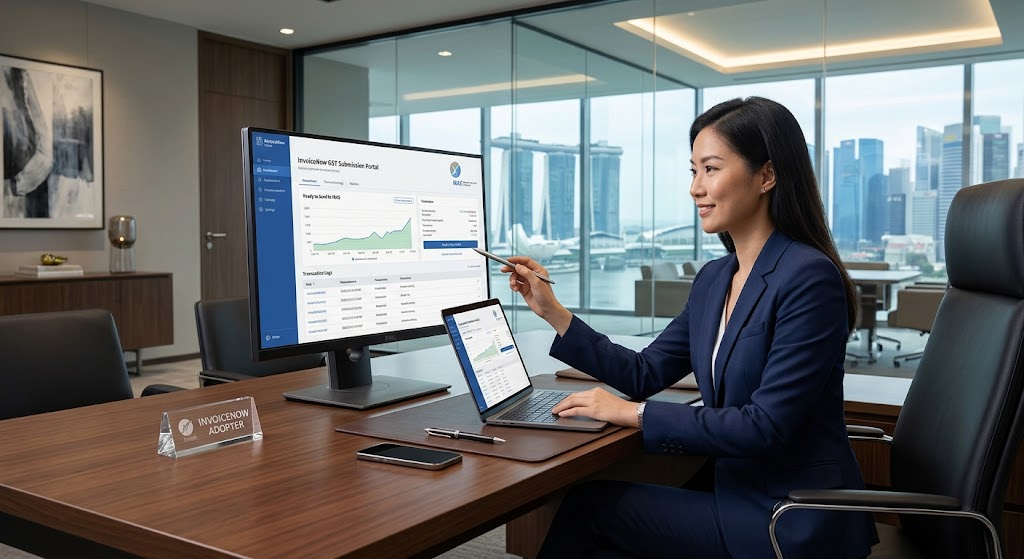
Business invoicing has traditionally involved preparing documents, sending emails, recording payments, and manually entering transaction details into accounting systems. Although these methods may work for smaller operations, they can become inefficient as a company handles more customers, suppliers, and financial transactions.
Singapore is moving towards a more connected digital invoicing environment through InvoiceNow, its nationwide e-invoicing network. Supported by the Infocomm Media Development Authority (IMDA) and connected to the Inland Revenue Authority of Singapore (IRAS) for GST invoice-data submission, this initiative is changing how businesses manage financial information.
For companies looking to improve their administrative processes, invoicenow iras represents an important development in digital invoicing and tax compliance. Understanding its features, advantages, and implementation requirements can help businesses prepare for a more automated way of working.
1. Understanding What InvoiceNow Actually Means
InvoiceNow is Singapore’s nationwide e-invoicing network, introduced in 2019. It uses the international Peppol standard to allow businesses to exchange invoices electronically through compatible accounting and finance systems.
Unlike traditional PDF invoices, structured electronic invoices contain information that software can recognise and process automatically.
For example, when a supplier sends an electronic invoice through the network, the receiving business can obtain the relevant information directly in its accounting solution. This reduces the need to download documents and manually enter invoice details.
The network supports business-to-business invoicing and provides the infrastructure for businesses to submit relevant invoice data to IRAS under the GST InvoiceNow Requirement.
2. Why Singapore Is Moving Away from Manual Invoicing
Manual billing creates several challenges for growing companies. Employees may need to prepare invoices individually, check customer details, calculate taxes, send documents, and update accounting records.
Every additional manual step creates another opportunity for mistakes.
Common problems include incorrect invoice amounts, duplicate entries, missing documents, delayed approvals, and incomplete transaction records.
Digital invoicing helps address these issues by allowing compatible systems to exchange structured information.
Singapore’s wider digitalisation efforts aim to make business transactions more efficient while improving the quality of information available for financial administration and tax compliance.
For companies handling regular transactions, moving towards automation can reduce repetitive work and allow employees to concentrate on more valuable activities.
3. How InvoiceNow Connects with IRAS
The connection between InvoiceNow and IRAS is particularly relevant to GST-registered businesses.
Under the GST InvoiceNow Requirement, affected businesses must use InvoiceNow-Ready Solutions to submit specified invoice data to IRAS through the network.
When the business activates the relevant submission feature, invoice data is transmitted through an IMDA-accredited Access Point Provider (AP).
This process allows IRAS to receive relevant transaction information electronically instead of relying entirely on businesses to prepare separate invoice-data submissions.
It is important to understand that ordinary participation in InvoiceNow does not automatically mean invoice data is being sent to IRAS. Businesses must activate the specific GST InvoiceNow submission feature when required.
4. Understanding the GST InvoiceNow Implementation Timeline
The requirement is being introduced progressively so businesses have time to prepare their systems and processes.
The implementation schedule includes the following key dates:
| Implementation date | Businesses affected |
| 1 November 2025 | Newly incorporated companies applying for voluntary GST registration within six months of incorporation |
| 1 April 2026 | All new voluntary GST registrants, regardless of incorporation date or business structure |
| 1 April 2028 | New compulsory GST registrants and existing GST-registered businesses with annual supplies of S$200,000 or less |
| 1 April 2029 | Existing GST-registered businesses with annual supplies of S$1 million or less |
| 1 April 2030 | Existing GST-registered businesses with annual supplies of S$4 million or less |
| 1 April 2031 | Existing GST-registered businesses with annual supplies above S$4 million |
The relevant implementation date for existing businesses is determined using the prescribed annual supplies information and IRAS guidance. Businesses should check their individual notification or use the official implementation-date calculator rather than relying only on the general schedule.
Certain businesses, including overseas entities and businesses liable to register wholly under the reverse charge regime, are excluded from the requirement under the applicable rules.
5. The Main Benefits of Digital Invoice Automation
One of the biggest advantages of InvoiceNow is the reduction of repetitive administrative work.
When businesses use compatible systems, invoice information can move between organisations without requiring employees to re-enter every detail manually.
This can create several operational benefits.
Fewer manual errors: Automated data exchange reduces the risk of typing mistakes, incorrect amounts, and duplicated information.
Faster invoice processing: Suppliers and customers can exchange structured invoices more efficiently, helping businesses manage billing and payment workflows.
Improved record organisation: Digital transactions can be recorded within accounting systems, making financial information easier to retrieve.
Better cash-flow management: More efficient invoice delivery and processing can help companies monitor outstanding payments and follow up with customers.
Stronger compliance preparation: Digital invoice data can support more organised GST reporting and reduce the effort involved in preparing separate transaction information.
These benefits depend on the quality of the selected software and the company’s internal procedures.
6. What Types of Invoice Data Must Be Submitted?
Businesses should understand that the GST InvoiceNow Requirement covers more than ordinary sales invoices.
In general, relevant invoice data includes transactions reported in GST returns, such as standard-rated, zero-rated, and exempt supplies and purchases.
Examples of documents may include:
- Sales invoices and tax invoices.
- Simplified tax invoices.
- Serially numbered receipts.
- Debit notes.
- Credit notes.
- Equivalent documents serving as bills for payment or adjustments.
Certain transactions do not require submission under the prescribed rules. These include specified reverse charge transactions, import permits for goods, and certain other excluded categories.
Businesses should consult the applicable IRAS guidance to determine how their particular transactions should be treated.
7. How Businesses Can Prepare for InvoiceNow
Preparing early can make the transition easier, especially for companies that currently rely on manual billing or older accounting software.
The first step is to review existing invoicing and financial processes. Identify how invoices are created, approved, recorded, and stored.
Next, check whether your current accounting solution appears on IMDA’s accredited InvoiceNow-Ready Solutions list.
Businesses using their own in-house enterprise systems may need to work with an IMDA-accredited Access Point Provider to establish the required connection.
The general onboarding process involves:
- Selecting an appropriate InvoiceNow-Ready Solution or Access Point Provider.
- Registering the business in the Singapore Peppol Directory using its UEN.
- Obtaining the company’s Peppol ID.
- Activating the GST InvoiceNow submission feature when applicable.
- Testing the invoicing and data-submission workflow.
Businesses should also train employees responsible for billing, accounting, and financial administration.
8. Choosing the Right InvoiceNow Software
Not every accounting solution provides the same features. Companies should evaluate their requirements before selecting a provider.
Consider whether the software supports sales invoices, purchase invoices, credit notes, GST calculations, payment tracking, and integration with existing accounting processes.
Also examine its reporting capabilities, user permissions, data security, customer support, and subscription costs.
Small businesses may prefer a straightforward solution with basic invoicing and accounting functions, while larger organisations may need integration with enterprise resource planning systems.
Singapore also provides access to free-of-charge InvoiceNow solution packages for eligible GST-registered businesses. These packages are intended to support basic e-invoicing requirements, subject to the applicable conditions and availability periods.
9. Important Compliance Responsibilities Businesses Should Remember
Although automation can simplify financial administration, it does not remove a company’s legal responsibilities.
Businesses remain responsible for filing accurate GST returns, maintaining proper accounting records, and complying with applicable invoicing rules.
GST records generally need to be retained for at least five years under the relevant requirements.
Companies must also ensure that invoice information is accurate before submission. Incorrect transaction classifications, missing details, or inaccurate tax treatment can still create compliance problems even when the information is transferred automatically.
Digital systems should therefore be supported by regular internal checks and appropriate accounting procedures.
10. Financial Support for Businesses Adopting InvoiceNow
The transition to digital invoicing may involve software subscriptions, system configuration, employee training, and operational adjustments.
To support adoption, Singapore has introduced assistance for eligible businesses.
The GST InvoiceNow Transition Grant provides up to S1,000foreligibleSMEswithannualsuppliesofS4 million or less and up to S$5,000 for eligible larger businesses.
Free-of-charge InvoiceNow solution packages are also available to eligible GST-registered businesses, subject to the applicable programme conditions.
Businesses should review the latest IMDA information before applying because grant eligibility, application procedures, and available solutions may be subject to specific requirements.
Conclusion
The transition from manual billing to digital invoicing represents an important development in Singapore’s business environment. InvoiceNow allows companies to exchange structured electronic invoices, improve financial workflows, and prepare for more connected tax administration.
For businesses exploring invoicenow iras, understanding the technology and its regulatory requirements is essential. Selecting suitable software, obtaining a Peppol ID, activating the appropriate submission feature, and maintaining accurate accounting records can make the transition more manageable.
As Singapore continues expanding the GST InvoiceNow Requirement, businesses that prepare their systems early can improve operational efficiency while building a stronger foundation for future digital transactions.